Trending

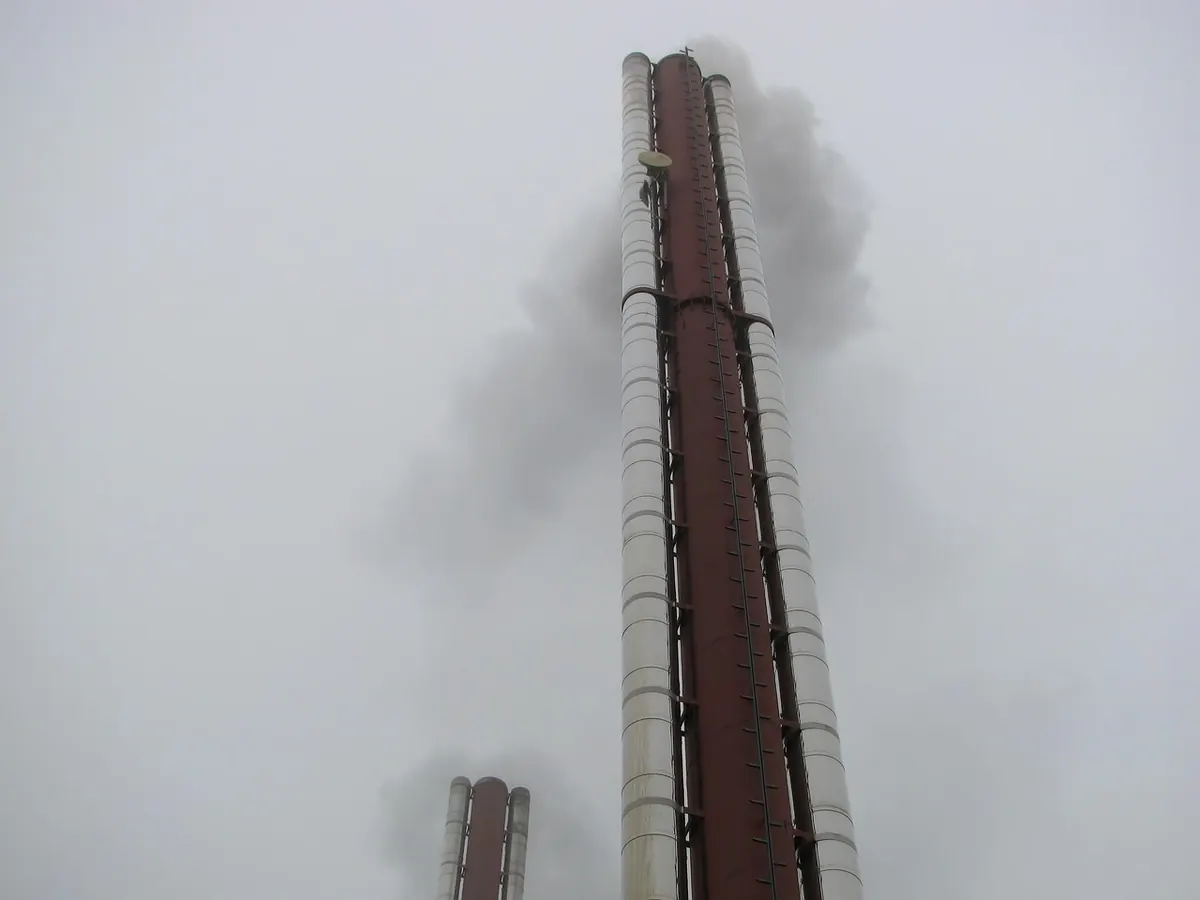
A flare tip is not glamorous kit, but the assist medium you choose shapes a great deal of what follows: utility bills, the maintenance calendar, plot space, and whether the flare smokes at the worst possible moment. Steam and forced air are the two mainstream answers for smokeless operation. Both work. They fail differently, cost differently, and suit different sites.
Smoke forms when hydrocarbon molecules at the tip run short of oxygen and residence time. Instead of burning through to carbon dioxide and water, they crack and polymerise into soot particles, which glow orange and carry over as a visible plume. An assist medium attacks that problem in two ways: it entrains and mixes air into the combustion zone, and it drives the early reactions that break heavy molecules apart before they can become soot.
Steam and forced air both do this, but at very different mass flows. A steam ring injects a controlled trickle of steam. An air-assisted tip moves a far larger volume of air, which is why its ducting and blower dwarf a steam manifold.
Steam is injected through a ring of nozzles around the tip, through centre spuds, or both. Good designs let you modulate steam flow independently of flare gas flow, so you can trim the ratio up when the gas is heavy or unsaturated and ease it back when the flow is light. That modulation is the main operational advantage: wide turndown, controllable smokeless capacity, and a flame you can shorten or lengthen by adjusting the ratio.
Steam also cools the tip, which helps tip life on high-radiant duty. The trade-offs are equally clear. Steam is a real operating cost, and it usually comes from the same header that feeds process users, so consumption competes with production. Wet steam and condensate slugs hammer and erode tip nozzles. Over-steaming lifts the flame, raises noise and combustion instability, and wastes steam; under-steaming gives you smoke. And when the plant trips, steam header pressure can fall at precisely the moment you need assist most.
Designs vary. A forced-draught blower at grade pushes air up a dedicated duct inside or alongside the riser to a manifold at the tip, where jets or vanes entrain flare gas into a well-mixed flame. Some designs instead inject high-pressure air through small tip nozzles, which gives finer control at the cost of a compressor load.
The attraction is straightforward: air is free, electricity is usually easier to supply than medium-pressure steam, and the flare does not depend on the steam header staying up. Performance is good across a wide range of gases, including low-pressure waste streams that are awkward to burn otherwise.
The costs sit in capital and in the blower. Ducting, blower housing, motor, starter, dampers, controls and the extra structural load on the stack all add up, and they take plot space at the base of a structure that is often crowded. Blowers have limited turndown: below a certain gas flow the air exceeds what the flame needs, and the machine runs inefficiently. Coastal or humid sites corrode ductwork from the inside, and a power failure stops the blower unless you have a credible backup.
Steam-assisted tips ask for attention in the pipework as much as at the tip. Traps, insulation, drains and strainers need a routine. Condensate that gets through will erode nozzles or crack the tip. Thermally cycled tips distort, and a partly blocked steam hole shows up as a persistent smoking patch on one side of the flame. Tip inspection usually means a shutdown or a thermal survey, so the cost of a marginal design is felt for years.
Air-assisted flares shift the workload to rotating equipment. Bearings, belts, couplings, dampers and starters need scheduled checks, and ducting needs internal inspection where condensation collects. Keep a running log: a slow rise in current draw or vibration tells you something long before the flare misbehaves.
Most decisions come down to two questions: what is in the gas, and what does your site have plenty of? Where a reliable, reasonably priced steam header exists and the waste gas is heavy or highly unsaturated, steam-assisted flaring is hard to beat, and the modulation makes life easier for the panel operator. Where steam is scarce, costly or unreliable, and where electrical power with credible backup is available, an air-assisted design usually gives better long-run economics and removes the dependency on the steam header.
Whichever route you take, write the operating ratios into the flare procedure and the control logic, not just the datasheet. Review the tip by thermal imaging or visual survey after the first significant relief event, and trend assist flow against gas flow for a few months. A flare set up correctly at commissioning tends to stay manageable; one left to find its own way at the tip rarely does.
Photo: jingoba / Pixabay